Bookmark Beat: EP 25
Published on Mar 1, 2026
If you’re receiving this newsletter, it’s because you signed up for the Bookmark Beat sometime in the past 4 years. Thanks for sticking with me and “hello” to all you newcomers! I think you’ll like this one.
The original idea for this newsletter was originally pretty simple. Share the links I collected across the internet every week and maybe add a couple thoughts about why each website/article/artwork stood out to me. Over time, I started adding more thoughts from my life - including reflections on what it meant to be a designer, frontend engineer or really anyone who cared about how people used the things we made. I also ended up wroting a little less often than once a week 😅
It’s been a year since my last newsletter. But in the present moment, with all the changes we’re seeing in the industry (be it automation, layoffs or whatever the hell this was), I feel that it’s more important than ever to not keep my thoughts to myself. Whenever I share my ideas with others, I find that I often end up learning more…
So, if anything in this newsletter resonates with you (especially in the “B” section), please do comment or reply! I respond to every message.
“A” Section: This Beats’ Bookmarks
Stories from outside the “tech” industry
The hardest working font in Manhattan by Marcin Wichary
By the time I learned about this, seven years in, I’ve become truly obsessed with Gorton and made it public by writing about it in my newsletter.
My every walk in Chicago or San Francisco was counting down “time to Gorton” – sometimes mere minutes before I saw a placard or an intercom with the familiar font. …And, for a font that didn’t exist, I saw it surprisingly often.
SPOTS: A Research Piece On Modern Street Skating by Place Magazine (Video)
If you have ever observed the behavioral patterns of skateboarders you have more than likely witnessed them skateboarding where they shouldn’t. Although this tendency is not observed in every skater over the years, researchers have noticed a correlation between the act of riding a skateboard and electing to skate where it is not allowed.
Mirror’s Edge: An oral history by Lewis Gordon
It’s easy to think that such a one-off experience emanated from the grand vision of a single creator. But according to the nine people who worked on it that we spoke to for this story, that’s not the case. Between years of experiments, abandoning dark and gritty concepts, bringing in a star of European art house cinema, finding an art style that worked both aesthetically and navigationally, deciding on a title, and later dabbling in sequel ideas, Mirror’s Edge was a concept that evolved slowly over time.
The Visual World of ‘Samurai Jack’ by Animation Obsessive
He wanted to treat background paintings like classic movies treat landscapes — which wasn’t done on American television. But Samurai Jack did it. And Wills’ painting techniques… made it possible.
Design thoughts (and rants)
Are we stuck with the same Desktop UX forever? by Scott Jenson (Google/Mastodon/Home Assistant)
And of course, who doesn’t love liquid glass? I mean, if all you’re doing, if your big claim to fame to your operating system is that you’ve got some fancy shiny pixels, you’ve really lost the plot. So, I think there’s very little leadership that comes from [Apple]. And I don’t think Microsoft is doing frankly that much better either.
The Sad Middle by Matthew Oliphant
Here’s what The Sad Middle looks like in practice: You spend two weeks researching a problem (if you’re lucky). You explore it with users. You have data, quotes, video clips of people crying… You design a solution. It’s good. You know it’s good because you tested it and people tell you it’s good (plus their capability matches what they think they can do!)…then it sits in the backlog for four months because Engineering is dealing with tech debt. … Even when it eventually gets built, half the scope gets cut.
Decentralizing quality by Matt Ström-Awn
Centralized quality just doesn’t last. It relies on the willpower of leaders, on slogans and dashboards that fade when the room changes. Decentralized quality is harder to build, but it compounds: every frontline decision, every local improvement, every user-validated feature adds to a system that grows stronger over time.
It’s hard to justify Tahoe icons by Nikita Prokopov
I could’ve given it a shot, maybe, if Apple applied these consistently. But Apple considers and to mean the same thing in one place, and expects me to notice minute details like this in another?
Sorry, I can’t trust you. Not after everything I’ve seen.
Design (and art) in the AI era
Why Designers Can No Longer Trust the Design Process by Jenny Wen
With AI accelerating prototyping, smaller teams doing more, and craft becoming a key differentiator, rigid processes are failing designers. Jenny shares real examples from Figma and Anthropic that show how great work actually gets made today. Starting from solutions, caring deeply about details, building intuition, skipping steps, and designing for delight.
The Rise of the Model Designer by AI Design Field Guide (an interview with Barron Webster, Figma/Replit/Google)
A big part of what design and research are doing now is ensuring the team stays focused on the right thing. It’s easy to start building a feature, encounter technical hurdles, solve them, find more, and end up with something technically functional but overly complicated for the user or drifted from the original goal.
What happens when the coding becomes the least interesting part of the work by Obie Fernandez
But if the part you care about is the decision-making around the code, agents feel like they clear space. They take care of the mechanical expression and leave you with judgment, tradeoffs, and intent. Because truly, for someone at my experience level, that is my core value offering anyway. When I spend time actually typing code these days with my own fingers, it feels like a waste of my time. If that time is being billed to my client at my expensive hourly rate, I feel even worse about it.
Design as Governance by Marzia Aricò and Giulio Frigieri
If governance is the scaffolding, mapping is the engine that powers it. Mapping is how enterprises make complexity legible. It’s how contradictions, blind spots, and hidden values are surfaced before they calcify into risk.
In AI systems, mapping exposes the Product Trap (features pushed over values), the Quant Trap (metrics over meaning), and the Agile Trap (speed over risk awareness).
Is AI ruining music? by Dustin Ballard (TED Talk)
What makes music “real” — is it the instruments, the voice, the creator’s intention or something else entirely? Dustin Ballard, the creative force behind the viral channel “There I Ruined It,” explores the weird, wonderful and sometimes unsettling ways AI is reshaping music. With fiddle solos and AI-powered mashups of your favorite songs, he invites us to ask: Are new tools fostering creativity, or just making noise?
Other cool things from the internet
- Yamonotes is a music box of train station melodies from the JR Yamanote Line. It makes me feel like I’m in Japan no matter where I am.
- Figma Console MCP: AI-Powered Design System Management That Changes Everything demonstrates how a homegrown MCP from Southleft can let you drive Figma from any AI agent. I’ve been using it recently for complex find-and-replaces and boring tasks like rearranging frames on the canvas.
- The Resonant Computing Manifesto lays out 5 principles for software development in this era. I believe in values-based decision making and find these principles particularly thought-provoking.
- Line scan camera image processing is a step-by-step breakdown of how Daniel Lawrence Lu creates beautiful time-lapses with the smallest slices of images.
- Department Store Catalogs is a collection on The Internet Archive of catalogs from Department Stores of the 20th Century. Makes me want to do some collages!
- RampenSau is a lightweight, dependency-free and blazingly fast color generation library. It makes use of hue cycling and easing functions to generate pleasing color ramps.
Life is for learning: free internet resources that I found this month
- Recreating Daft Punk’s Something About Us is an in-depth, personal journey recreating Daft Punk’s “Something About Us” in Ableton Live 12 — track by track. From synths to talkbox guitars, a nostalgic dive into French Touch culture, sound design, and the joys of music production.
- Methodical UI: removing frustration from HTML and CSS development provides a crash course in how to think about the browser, layout and all the weird words you need to know to make HTML/CSS not frustrating.
- Deep Dive into Atlassian’s Figma file is a walkthrough of Figma file organization, dev handoff process at Atlassian, and the good/better/best design framework at Atlassian.
- CARI, or Consumer Aesthetics Research Institute, is an online community dedicated to developing a visual lexicon of consumer ephemera from the 1970s until now.
- Post-Chat UI provides alternative interfaces for AI assistance. Not everything needs to be (or should be) a chat interface.
- Practical note-taking techniques every UX Researcher should know walks through everything from choosing the right tools to capturing the right levels of fidelity during user research.
That’s it for this curated collection of links. But if you’re looking for an always-up-date list of everything I’m listening to and reading, you can check out the “I am” page on my website.
Of course, if you’d rather just receive updates whenever I write this newsletter, you can do that by subscribing on Substack 📬
“B” Section: AI is short-circuiting the design thought process
I gotta say, it was really weird to go through an entire year’s worth of bookmarks. There were dozens of posts from last year that I ended up not including here since they were so weirdly off about the way AI would affect our jobs.
Over the course of the last year, people have gone from posting 16,000-word rants about how AI just “isn’t as good as people say it is” to saying things like “well sure, AI can make things now, but it doesn’t have taste or craft“.
I’m not an oracle and I can’t predict how much better these tools are actually going to get. But I think NNGroup’s State of UX 2026 summed up the feeling I have about all these changes pretty well:
2026 is shaping up to be the year of AI fatigue.
UX and product professionals are tired of being:
- told they’ll be replaced if they don’t “vibe code”
- sold slick tools that don’t actually integrate into real workflows
- forced to explain why automating critical decisions is risky (again)
- pressured to ship AI features because competitors did
- asked what share of their work could be handled by an AI agent
Users are fatigued, too. Lazy AI features and AI slop are now ubiquitous, and the shine is fading fast. When everything gets an AI sparkle, it becomes noise, not novelty.
Yet I am “vibe coding”. I am trying all these “slick tools” and getting frustrated by them. I am also lucky enough that my company values humans in the loop for decision making and isn’t just copying competitors whole-cloth. But damn is it hard to answer that question, “what share of design work could be automated by AI?”
The answer, like most things in our field, is “it depends.”
For example, I’ve been working on a Mac OS application to make it easier to sync files from my home media server to my partner’s old-school MP3 player. I’ve never written a single line of Swift in my life… yet I have a fully working native Mac app that does what I want it to do - all thanks to a free trial of GitHub Copilot and few dozen prompts.
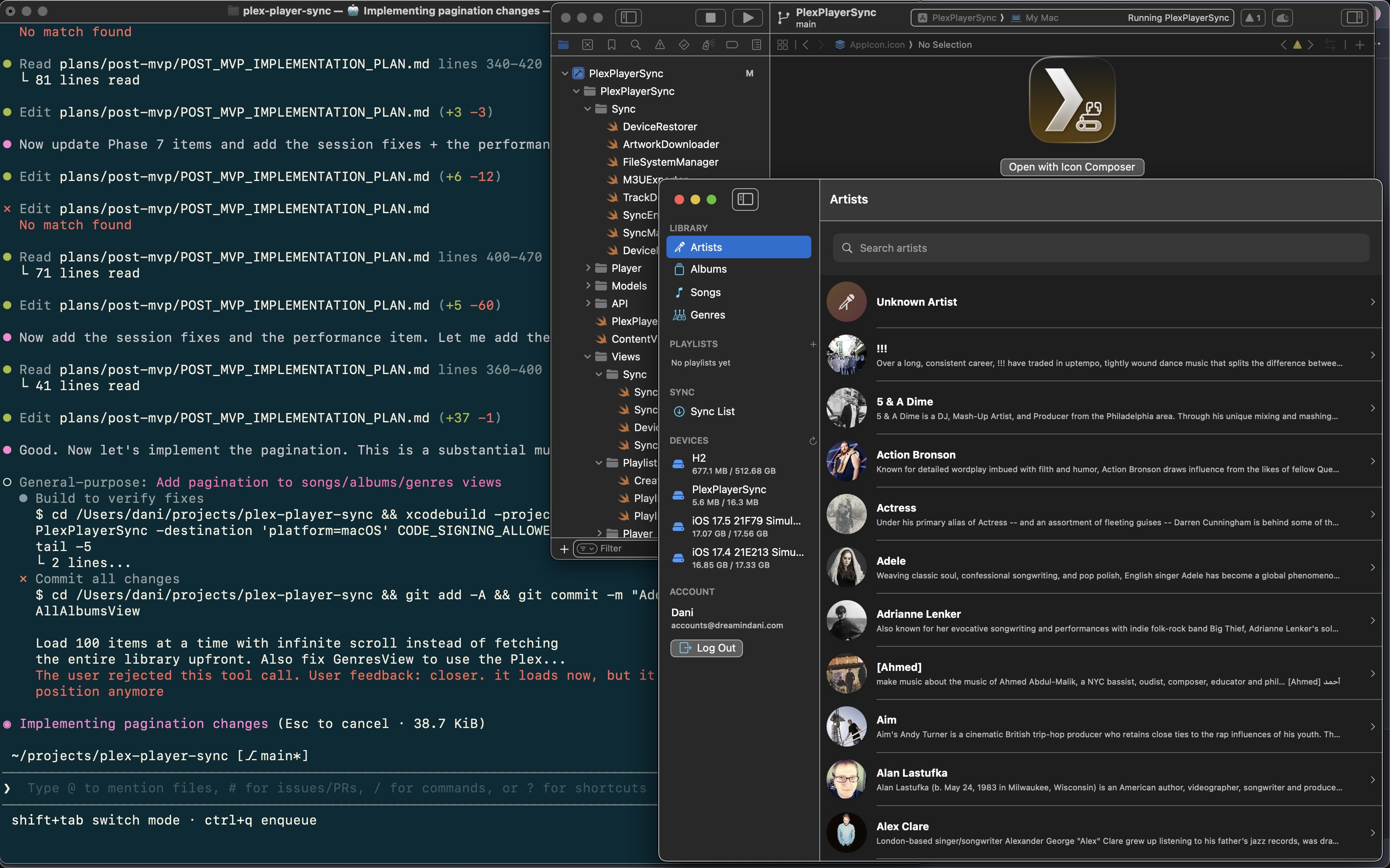 A peek at my “development environment” for PlexPlayerSync
This application is just for me and my partner. If I were to release it to the general public, I’m sure at least a dozen security vulnerabilities would be found in its first day. Yet it’s a real thing! It works and I didn’t have to mockup a single screen in Figma, work with a team of engineers or watch a dozen YouTube tutorials on Mac OS software development. All it took was a few bathtubs full of water (or maybe not)?
Is it well designed? No. Actually it’s still a little annoying to use. But my feedback loop is very quick. I watch my partner use it, see where she’s struggling and update it. In less than half an hour, I can spin up a new version and have her try it again.
AI feels like it actually works now. It’s helping me complete side projects that I would have been too afraid to even start this time last year. Yet it’s costing me something more than the $10 / month that I’ll likely end up paying once this Copilot trial expires.
I feel like my workflow, my approach to problem solving and my brain itself is changing. And I know I’m not the only one.
The tradeoffs of fast feedback
When I first started using AI to write code, I was constantly frustrated by it. I’d ask it to make something look a certain way or to solve a problem on its own. Then I’d almost immediately interrupt it when I saw it going the wrong way. In the past, that’d be enough for me to just give up and write the dozen or so lines of code myself. But recently, I’ve figured out what context I must have missed in my first prompt and try again. It usually works the second time.
Similarly, I would often shoot off a prompt to fix something only for the AI to spend 5-10 minutes iterating on its own. During this time I spent waiting, I had to do something. So I either Alt+Tab’d to read 3 paragraphs of an article or jumped into designing something. Either way, I’d be interrupted by a notification from the agent mid-thought. The context shifts were painful and usually led to me feeling like I couldn’t really “start” anything meaningful as long as I was having an AI write code for me.
But now I’m more willing to let an agent run wild on a problem without interruption. I feel more comfortable in both my prompting skills and its ability to self-correct. And I’m actually finishing things both outside and inside my code editor.
Yet I’m starting to think that there might be a downside to seeing our thoughts become reality so quickly…
Before, when software took more time to build (i.e. last year), we’d have to write out our hypotheses in the form of product briefs and project plans. To avoid spending time building the wrong solution, we might sketch out ideas on paper and convert them into a high fidelity design tool to see how things fit together. We might even talk to other people about whether or not the idea was good enough to throw a team of developers at it.
Now we can just see if it for real in working software.
As a fan of participatory design, where designers facilitate the actual users of software in building what they want, I actually think this will be a game-changer. I can imagine a room where I’m with real users of my product and we get to see their ideas come to life in real time… Not on a whiteboard, but in the real product with their actual data.
I also fear that if we’re too fast in granting our users’ wishes, we’ll be unable to see more than the simplest leaps of imagination in front of us. When software took a while, I took more breaks to think about things. When products took time to build, I took the time to ask more thoughtful questions.
Can we trust ourselves to keep asking these questions? Or are we all doomed to generate faster horses now?
Coda: Books I liked
Here’s some of my favorite books that I read over the last year or so:
- Silent Spring by Rachel Carson is one of the few non-fiction books that has made me cry. Written in 1962 and a cornerstone of the modern environmental movement, it changed the way I see our planet and our role as stewards of it.
- Careless People by Sarah Wynn-Williams could be a comedy if it wasn’t so scary. Covering the rise of Meta’s influence on how the world viewed itself, Sarah shows what it was like on the inside close to Sheryl, Mark and other early Facebook leaders.
- Children of Time by Adrian Tchaikovsky made me like spiders. It’s an excellent story about the purpose of civilization, the relativity of truth and it features some really cool space stuff!
- Okinawa by Susumu Higa is one of the most impactful manga I have ever read. This collection of stories starts in middle of WWII and ends with more recent depictions of life on the southern islands of Japan. It directly deals with the consequences of American occupation and the Japanese erasure of culture within Okinawa.
- Eden II by K. Wroten is one of the weirdest comics I’ve ever read. Its use of color, point of view and allusions to our present day capitalist environs makes it just accessible enough to handle the queer punk-rock dystopia it depicts.
- Frontier by Guillaume Singelin is a beautiful story about the consequences of tying scientific discovery to the priorities of industry. Although the art might look cute on the surface, the depth of its characters and alien planets made me want to live in its universe for just a little while longer.
That’s all for this EP 💽! I think I’ll start doing these more often again. What do you think? Is there anything in here that stood out to you? Or maybe things you don’t want to see? Feel free to ping me in the comments on Substack (or just send me an email).
Catch ya next beat 🥁😎🥁